

Jaume Rafols
6 November 2026
The missing piece: bringing up to 15 years of support to Zephyr for microcontroller-based ECUs
We recently announced the launch of Zephyr 26.04 LTS, bringing up to 15 years of security maintenance per LTS and enterprise lifecycle management to microcontroller-grade devices.
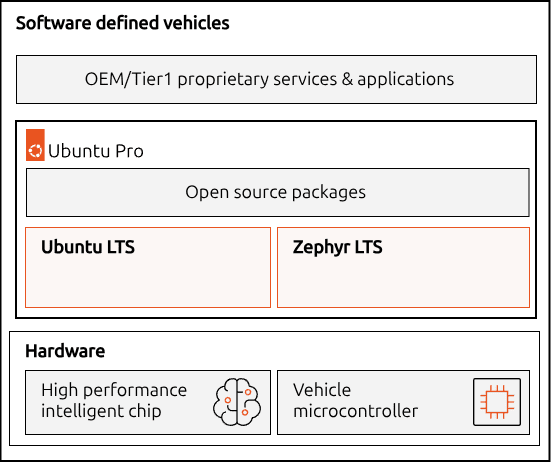
While central high-performance computer ECUs capture most of the industry spotlight in software-defined vehicle (SDV) architectures, the operational reality of modern vehicles is far more distributed. Under the chassis sit hundreds of microcontroller-based electronic control units (ECUs) managing real-time sensor loops, power distribution, and domain specific control tasks.
These lightweight microcontrollers (MCUs) present a huge cybersecurity vulnerability if left unmanaged over multi-decade vehicle lifecycles. With Zephyr LTS, those same MCUs now receive long-term support, expanding support across the entire software-defined vehicle (SDV) architecture.
The compliance gap
Traditional MCU lifecycle management relies on custom downstream open-source forks or proprietary RTOS distributions. This creates an unsustainable, fragmented engineering burden:
Engineering silos: In-house teams spend thousands of hours applying security patches to legacy RTOS forks rather than building new product developments.
Supply chain vulnerabilities: Unpatched microcontrollers can become backdoors into primary vehicle buses like CAN or Ethernet AVB.
Compliance bottlenecks: Tracking SBOM across dozens of disparate vendor toolchains and SDKs slows regulatory audits and increases liability risks under ISO/SAE 21434.
Turnkey compliance and enterprise lifecycle support
Maintaining cybersecurity across a decade-long vehicle deployment demands a stable, predictable foundation. Zephyr 26.04 LTS addresses technical debt and regulatory mandates through key capabilities:
- Up to 15 years of support per LTS: Canonical provides CVE monitoring, security patching, and SBOM generation for up to 15 years. This removes long-term compliance friction for automotive fleets.
- Predictable release cadence: Zephyr LTS mirrors Ubuntu’s established release cycle, delivering LTS releases every two years and interim updates every six months to provide dependable roadmap predictability.
- Full stack tooling coverage: We maintain the core Zephyr’s RTOS kernel alongside essential build tools like West (Zephyr’s meta-tool for building, flashing, and managing repositories).
Development agility with Canonical Workshop
Decoupling hardware from software requires frictionless developer tooling and reliable remote deployment mechanisms. To accelerate time-to-market and streamline onboarding across distributed teams, Zephyr LTS integrates Canonical Workshop.
Canonical Workshop is an open-source tool developed by Canonical that launches sandboxed, reproducible development environments on Ubuntu using a single command. Using the Workshop SDK for Zephyr 26.04 LTS, developers can access a ready-to-use Zephyr LTS environment on any hardware, complete with essential build tools. This allows engineering teams to bypass complex local toolchain configurations and execute tools like West immediately.
Zephyr LTS delivers the deterministic real time performance for your critical tasks, andCanonical manages the long-term security, compliance and patches –enabling your developers to ship features rapidly.
Get in touch with our automotive experts
Navigating multi-decade security maintenance and regulatory compliance does not have to slow down your engineering teams. Whether you are architecting next-generation SDVs or looking to secure MCU-class ECUs, our team is here to help.
Contact our automotive team today to discuss your architecture requirements, request a demonstration, or explore how Zephyr LTS fits into your production roadmap.


